
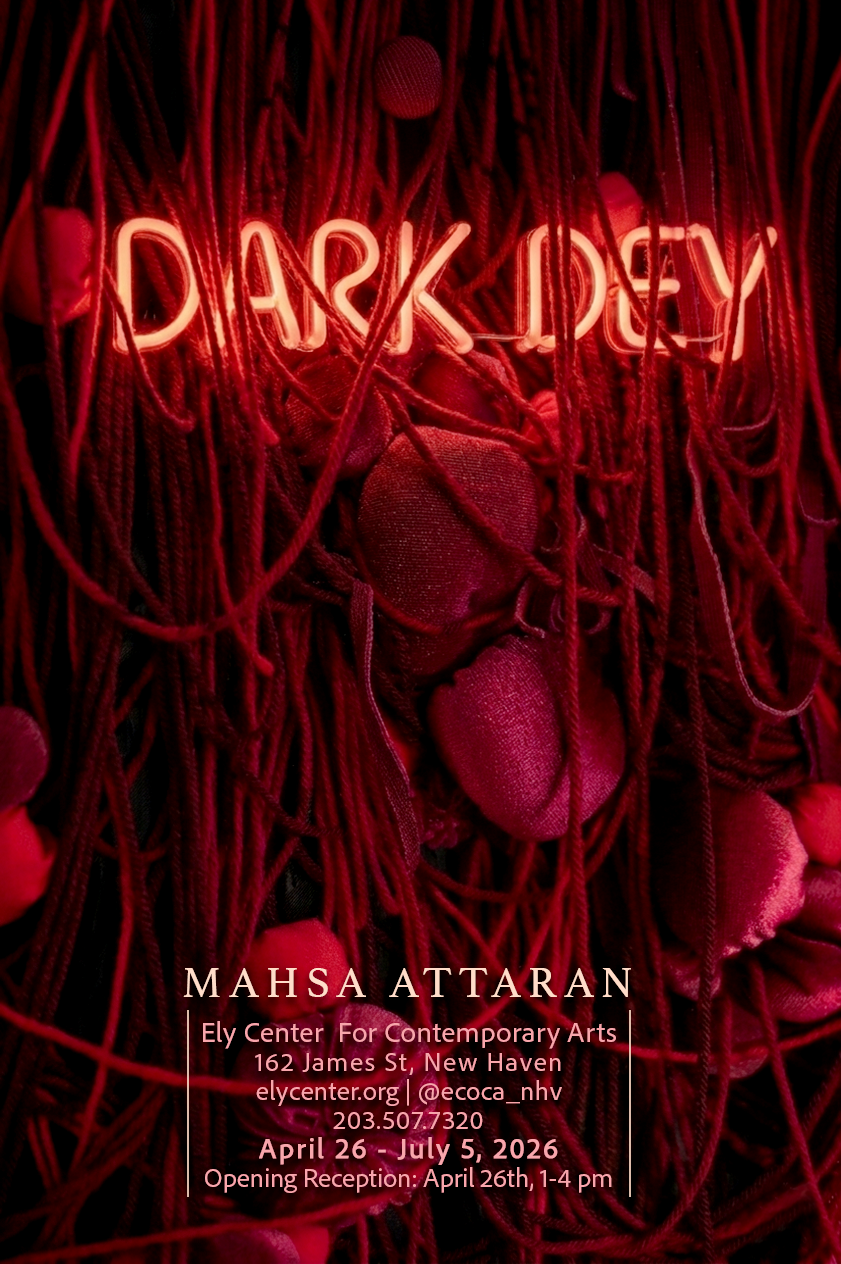
Mahsa Attaran
DARK DEY
Exhibition Dates: April 26 - July 5, 2026
Opening Reception: April 26, 1-4pm
DARK DEY emerges from love for Iran and the urgency of witnessing its present history. Created in exile, Mahsa Attaran’s work responds to ongoing state violence, gendered oppression, and the massacre of over 50,000 civilians across two days—DEY 18th and 19th (January 8–9, 2026)—during the continuing revolution. It stands as both testimony and refusal of silence.
Working from a distance, Attaran positions herself as both witness and subject, tracing how this violence is carried across borders and into the body. Her work reflects the condition of diaspora of living a daily, outwardly ordinary life while remaining internally bound to a homeland in crisis. The experience of teaching, working, and moving through professional space exists alongside an ongoing awareness of loss, where the weight of what is happening to loved ones is continuously present, though often unseen.
Attaran’s practice centers women’s lives, domestic space, and acts of care as sites of political meaning. Her work confronts violence sustained through patriarchal power, religious authoritarianism, and the laws of an extreme Islamist regime, while holding space for the resilience of those living within it.
Addressing particularly Western audiences, the work calls attention to life under state-enforced Sharia law, where rights are known yet systematically denied. Rejecting ideology, it insists instead on lived experience and the ongoing pursuit of dignity, safety, and self-determination.
Rooted in devotion to her homeland and its people, this work is an act of love. It asks viewers to witness, to remain with discomfort, and to recognize that this violence is not distant, but ongoing.
Mahsa Attaran is an Iranian-born visual artist, photographer, and educator whose work explores culture, gender, and belonging through memory, exile, and domestic archives. Working across photography, video, installation, and conceptual wearables, she often uses the archive to preserve and reframe women’s histories. Her work has been exhibited internationally, including at the Iranian Artists Forum in Tehran, Ball & Socket Arts in Cheshire, TheatreWorks in Hartford, and The Sue & Eugene Mercy Jr. Gallery in Windsor, and has been featured in publications such as Hyperallergic and Midbrow.
As an Iranian woman in exile, Attaran is committed to witnessing and refusing silence in the face of political violence and human rights abuses. She also leads workshops and talks that encourage critical engagement with social justice, memory, and responsibility. Attaran holds an MFA in Studio Art from the University of Connecticut and teaches on the Visual Arts faculty at The Loomis Chaffee School.